Periodic Chemistry - The Periodic Table
This simple guide to the Periodic Table introduces chemistry concepts in terms that beginners can understand. Unravel the complexity of the Periodic Table chart and understand the rationale behind Periodic Chemistry. Periodic ChemistryPeriodic Chemistry - The Periodic Table
The Periodic Table can be used by chemists in Periodic chemistry to observe chemical and physical properties, characteristics, patterns and relationships between over 100 elements in just one chart as detailed in the Modern Periodic Table with names of the elements. The Periodic Table is an arrangement of the chemical elements arranged in order of Atomic number, usually in rows, so that elements with similar atomic structure (and hence similar chemical properties) appear in vertical columns. The Periodic Symbols are also included on the Periodic Table. The Periodic Table is the cornerstone of Periodic Chemistry. Periodic Chemistry - What is Matter?
To understand Periodic Chemistry and the elements we need to ask a basic question. What is Matter? Matter is everything that takes up space and has weight – matter has volume and mass. Matter is made up of tiny building blocks called Atoms… Periodic Chemistry - Atoms and Compounds
What is the connection between Atoms, Periodic Chemistry and the Chemical Elements? Chemistry is the science of chemical elements and compounds and how these things work together. A chemical element contains only one type of atom. If a substance contains more than one type of atom, it is a compound. Periodic Chemistry - Atoms - Protrons, Neutrons and Electrons
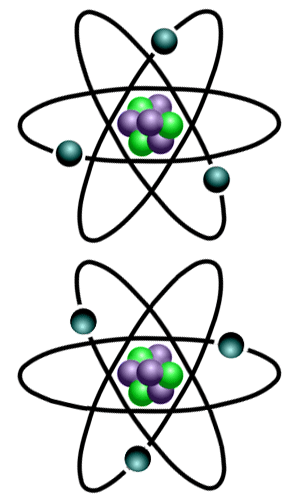
Atoms are composed of three kinds of smaller particles, called protons, neutrons and electrons. These particles all have different properties. Electrons are tiny, very light particles that have a negative electrical charge. Protons are much larger and heavier than electrons and have a positive charge. Atoms must have equal numbers of protons and electrons. Neutrons are large and heavy like protons; however neutrons have no electrical charge. The nucleus is in the middle of the atom & contains protons and neutrons. Protons and neutrons are made up of even smaller particles called quarks. Periodic Chemistry - Atoms
Atoms are very small – at least a hundred times smaller than the width of a human hair. The exact size of the atom changes, depending on the element. Atoms are electrically neutral, with a positively charged nucleus that binds one or more electrons in motion around it. The purest type of atom is called an element. We now understand the relevance to Periodic Chemistry. Periodic Chemistry - States of Matter - Liquid, Solid or Gas
An element can be a gas, a liquid or a solid. These are called States of Matter and often referred to in Periodic Chemistry. The number of protons, neutrons and electrons an atom has determines what element it is. Periodic Chemistry - Chemical Elements
There are over 100 different chemical elements that are known to modern chemistry and studied in Periodic Chemistry. 92 of these elements can be found in nature. 26 of these elements can be found in the human body and the remaining elements are man- made in laboratories. All of the elements are detailed in the Periodic Table are studied in Periodic Chemistry. Periodic Chemistry - Observing characteristics, properties, patterns and relationships of elements
The Periodic Table is used in Periodic chemistry by chemists and scientists to observe characteristics, properties, patterns and relationships between over 100 elements in just one chart. The Periodic Table is organized like a big grid. The elements are placed in specific places because of the way they look and act. An invaluable tool in Periodic chemistry. Periodic Chemistry - Physical States
In Periodic Chemistry the elements can be classified based on physical states. At room temperature and pressure the Physical States are solids, gases or liquids. Most elements are solids, only 11 are gases and 2 are liquids. Changes, such as pressure and temperature, can alter the Physical State of an element and can determine its relative density (mass or concentration), viscosity (how well it flows) and malleability (how easy it is to bend). Periodic Chemistry - Phase Changes - Melting, Freezing, Vaporization, Condensation
A phase change is the process by which the physical states of elements are altered and carefully studied in Periodic chemistry. For example, when a solid melts and becomes a liquid, it goes through a phase change. When a solid becomes a liquid, it is called melting. When a solid becomes a gas, it is called sublimation. When a liquid becomes a gas, it is called vaporization. When a gas becomes a liquid, it is called condensation. When a liquid becomes a solid, it is called freezing. All of these processes, called Phase Changes, are studied in experiments in Periodic Chemistry. Periodic Chemistry - Chemical Formulas
Chemical reactions convert one chemical substance into another. A Chemical formula is a type of shorthand for representing the elements in a compound. For example, the chemical formula for water is H2O which indicates that 2 atoms of Hydrogen combines with 1 atom of Oxygen. Periodic Chemistry - Melting Point of Elements - Sublimation
The melting point is one of several physical properties by which elements are identified in Periodic Chemistry. The melting point is defined as the temperature in which it moves from its solid state to its liquid state. Some substances do not have a melting point and will instead move from solid to gaseous state. This is known as sublimation. Periodic Chemistry - Freezing Point of Elements
The freezing point and the melting point are said to be the same. This is because any increase in temperature will cause it to melt and any drop in temperature will cause it to freeze. Periodic Chemistry - Classifications of Elements into Groups
The elements displayed on the Periodic Table and studied in Periodic Chemistry which consist of Gas, Liquid or Solid are placed in Periodic Table Groups and these are classified as: - Metalloids
- Alkali Metals
- Alkaline Earth Metals
- Transition Metals
- Other Metals
- Non-metals
- Halogens
- Noble Gases
- Rare Earth Elements
Each of these classes, or groups, have common properties and characteristics which are studied in Periodic Chemistry. Periodic Chemistry - Properties of Elements
The Periodic Table conveys some items of Element Classification at a glance. However, elements in the Periodic Table are classified by many other factors including: Atomic Mass, Atomic Radius, Melting Point, Boiling Point, Density, Mohs Hardness, Conductivity, Electro-negativity and Energy. Periodic Chemistry - The Theory of the Periodic Table
The following flowchart illustrates the process of Periodic Chemistry and of developing a scientific theory. 
Periodic Chemistry
For additional facts and information about the elements studied in Periodic Chemistry please click any of the above links. |