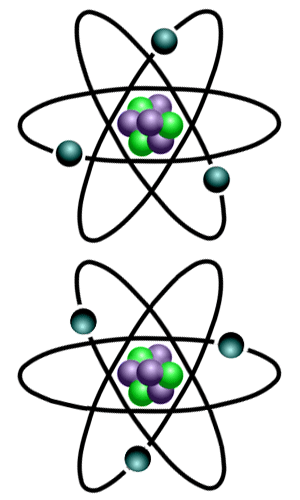
What is Beryllium? Origin / Meaning of the name Beryllium
The name beryllium comes from the Greek word beryllos meaning 'to become pale'. The word derives from the name of the the pale semi-precious gemstone called beryl which contains beryllium. What is Beryllium? Periodic Table Group and Classification of the Beryllium Element
Elements can be classified based on their physical states (States of Matter) e.g. gas, solid or liquid. This element is a solid. Beryllium is classified as an "Alkaline Earth Metal" which are located in Group 2 elements of the Periodic Table. An Element classified as an Alkaline Earth Metals are found in the Earth’s crust, but not in the elemental form as they are so reactive. Instead, they are widely distributed in rock structures. Nearly 75% of all the elements in the Periodic Table are classified as metals which are detailed in the List of Metals. Common properties of Alkaline Earth metals
The elements classed as "Alkaline Earth metals" have the following properties in common: - Shiny Solids
- Two electrons in the outer shell
- Can conduct heat or electricity
- Can be formed into sheets
Facts about the History of the Discovery of Beryllium Element
Beryllium was discovered in France by Nicolas-Louis Vauquelin in beryl and in emeralds in 1798 and was isolated as the metal independently by Friedrich Wöhler and A.A. Bussy in 1828. Nicolas-Louis Vauquelin also discovered beryllium. Nicolas-Louis Vauquelin rose from being born as the son of a peasant to an eminent chemist. He started his career working in an apothocary shop and then he became the laboratory assistant of Antoine-François Fourcroy before becoming an authority in his own right eventually chemistry professor at the Paris Faculty of Medicine. 
Nicolas-Louis Vauquelin (1763-1829)
What is Beryllium? Occurrence of the Beryllium Element
Beryllium is found in 30 different minerals
Minerals include bertrandite, beryl, chrysoberyl, and phenacite
Other precious forms of beryl are emerald and aquamarine
Mined in the USA, China, Russia and Brazil Abundances of the element in different environments
% in Universe 1×10⁻⁷%
% in Sun 1×10⁻⁸%
% in Meteorites 2.9×10⁻⁶%
% in Earth's Crust 0.00019%
% in Oceans 6×10-11%
% in Humans 4×10⁻⁸% Associated Uses of Beryllium
Alloying agent in the production of beryllium copper - non magnetic and non sparking tools
Spacecraft
Missiles
Aircraft
Communication Satellites
Gyroscopes
Beryl provides the green colour in emerald and blue in aquamarine gemstones |