|
Number of
Electrons - What are
Electrons?
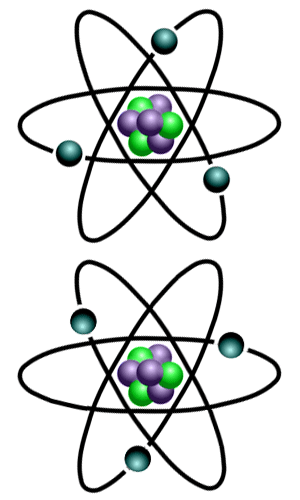
Electrons are
tiny, very light particles that have a negative electrical charge. Electrons are
negatively charged, circling the nucleus, making it a neutral, orbital particle.
Protons are
much larger and heavier than electrons and have a positive charge. Electrons are
positively charged and located in the nucleus together with the neutrons.
Electrons have a charge of +1 and a mass of approximately 1 atomic mass unit
(amu).
|
Protons, Electrons and Neutrons |
|
Particle |
Charge |
Location |
|
Proton |
+1 |
Nucleus of Atom |
|
Electron |
-1 |
Orbital |
|
Neutron |
0 |
Nucleus of Atom |
Atoms must have
equal numbers of protons and electrons
Number of Electrons - How to find the Atomic Number
of an element
Every element has a unique Element Symbol and a unique Atomic
Number which can be accessed via the
Periodic Table
with Atomic Mass.
You can also refer to the bottom of this page
to an at-a-glance chart of all the elements and their atomic
number in numerical order.
The Atomic
number = The Number of Protons in the atom of an element
Atoms must have
equal numbers of protons and electrons
Number of Electrons
Number of Electrons - How to find the Number of
Electrons - Examples
The atomic
number is based on the number of Protons in the atom of an
element. (Note: Atoms must also have equal numbers of Electrons
& Protons.) So, if we know the
atomic number
of an element then we also know how many Protons are in an element
and therefore the number of electrons in an element.
-
Example 1 - Number
of Protons in Gold: The element Gold (Symbol Au) has the Atomic
Number of 79. Any atom that contains exactly 79 protons in its
nucleus is an atom of gold. The number of protons in atom of
gold is therefore 79. And as there must be an equal number of
electrons and protons in an element there must also be
79
Electrons
in the element.
-
Example 2 - Number
of Protons in Silver: The element Silver (Symbol Ag) has the
Atomic Number of 47. Any atom that contains exactly 47 protons
in its nucleus is an atom of silver. The number of protons in
atom of silver is therefore 47. And as there must be an equal
number of electrons and protons in an element there must also be
47
Electrons
in the element.
-
Example 3 - Number
of Protons in Neon: The element Neon (Symbol Ne) has the Atomic
Number of 10. Any atom that contains exactly 10 protons in its
nucleus is an atom of gold. The number of protons in atom of
gold is therefore 10. And as there must be an equal number of
electrons and protons in an element there must also be
10
Electrons
in the element.
Refer to
the table below and work out the number of Electrons in various
elements.
Number of Electrons - How to find the Number of Electrons
Calculating
the number of Electrons in an atom or element by
using the atomic number and number of protons information.
|